The Stranger Test: Five Minutes Between Finished and Sent

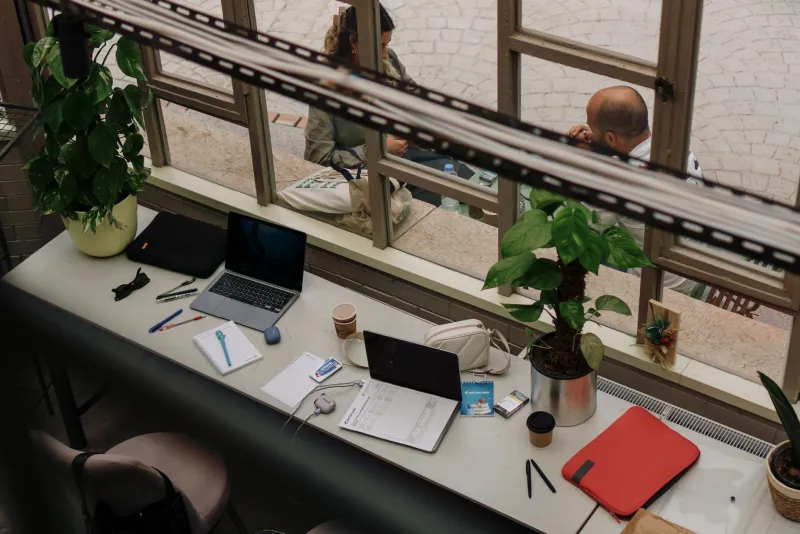
Photo: Jon Asato jon_asato, CC0, via Wikimedia Commons
It's usually about quarter to midnight when I catch myself doing it. The file is exported. The thumbnail's sitting there looking pleased with itself. My cursor is hovering over the send button and I'm thinking, right, that's done. And then I remember the thing I started doing about eighteen months ago, and I close the laptop instead.
Not because the work is bad. Because I've just spent three weeks watching it in fragments — scrubbing, stopping at 40% viewer size, jumping back four seconds to check a cut, watching it at double speed with a client's comments sitting in the corner of the screen. The version of that piece in my head is not the version that anybody else will ever see. So before it goes out, I have to go and meet it properly.
The person who cannot see your work
Here's the problem with finishing something: by the end, you know where all the seams are. You know the bit at 01:14 where the audio dips because of that room. You know the title card is a compromise. You know exactly why the third section is shorter than the others. None of that knowledge is in the file. It's in you, and it makes you a hopeless judge of your own work at the precise moment you need to be a good one.
So the fix isn't more notes or a longer checklist. It's pretending, for a few minutes, to be somebody who has wandered in cold.
What the blackout actually looks like
It's less dramatic than the name suggests. For anything up to roughly five minutes long, play the whole thing once, on a full screen, at a normal volume. If the piece is longer — a documentary short, a longer form film — take the first five minutes. Cold open. No context. That's the section that decides whether the rest gets watched anyway.
The rules are the rules, and they're deliberately boring:
- Phone in the other room. Not face down on the desk. In the other room.
- No pausing. Not even for the bit you're worried about. Especially not for the bit you're worried about.
- No second screen, no timelines, no player chrome if you can help it.
- Monitor at typical-sitting-room volume, not mixing volume. If it only works when it's loud, it doesn't work.
- One timed alarm if you're the sort of person who checks the clock. Then ignore it.
And yes, that means five minutes where you are doing absolutely nothing productive. That's the cost. Five minutes, once, on a piece you've already spent weeks on. It is the best-value five minutes in the whole process, and it's the one most of us skip because by then we're exhausted and the kettle is calling.
Three things you're actually looking for
I don't go in with a rubric. I go in with three questions, in this order.
Pacing. Where do I first want to reach for my phone? Not where does it drag in theory — where does my hand actually move. That's data. A drag you can feel in your own body is a drag an audience will feel with considerably less patience.
Clarity. If somebody tapped me on the shoulder at the end and asked what that was, could I answer in one line? If the answer is a paragraph, the piece hasn't told me what it is. That's usually a title card problem or an opening thirty seconds problem, and both are cheap to fix.
Credibility. Do I believe it? Does the thing being claimed on screen match the thing being shown? Does the tone of the opening promise the same film the ending delivers? Nine times out of ten when I feel a wobble I can't name, it's this. Not craft. Trust.
The no-notes rule is the whole thing
This is the part people skip, and it's the part that makes it work. No notes app during the watch. Not one.
The moment you start typing, you've turned a screening into an edit session. You stop being an audience and go back to being a person with a job, and the piece snaps back into fragments. You'll write down twelve things, nine of which are the same note wearing different hats, and you'll miss the one thing that actually mattered because you were busy typing.
So sit with it. Let it wash over you. Then walk to the kettle, and only write down what's still in your head when the water's boiled. If a note doesn't survive the kettle, it was probably never a real note. It was just you being nervous.
Where it has earned its keep
A short film that was, it turned out, about forty seconds too long at the front. Nothing wrong with any of those forty seconds individually. The piece just arrived before the audience did.
A documentary segment where the second interviewee quietly contradicted the first, and I'd stopped noticing somewhere around the ninth viewing. Once I watched it cold, the contradiction was the loudest thing on screen.
A showreel where the strongest single shot sat at 00:52 and, based on the analytics, roughly nobody had ever got that far. It's at 00:06 now.
None of those were caught by a checklist. All of them were caught by sitting still for five minutes and letting the work do its own talking.
The uncomfortable bit
Sometimes you do the blackout, and the piece is fine, and you still feel a drop somewhere in the middle. That's worth taking seriously but not worth panicking about. A maker's experience of a piece and an audience's experience of it are genuinely different things, and not every dip you feel is a fault in the work. Some of it is just the gap between knowing how the sausage got made and eating it.
Don't fix something that's only broken for you. Fix what the stranger would have noticed.
Making it stick
Put it in the calendar as a real slot, not a vague intention. Mine sits the day before delivery, never the same evening I finish, and never after 10pm — because at 10pm I'm not an audience, I'm a tired person who wants to go to bed and will approve anything.
If you work alone, this is your only screening. Treat it like one. Give it a fixed chair, a hard stop on changes afterwards, and a rule that nothing leaves the studio until it's had its five minutes.
It won't make the work perfect. It'll make it honest, and it'll catch the one thing a booker or a client would have spotted in the first thirty seconds. That's usually enough.