The Domain Is the Deal: What Choosing 'Me' Over 'Studio' Actually Costs You

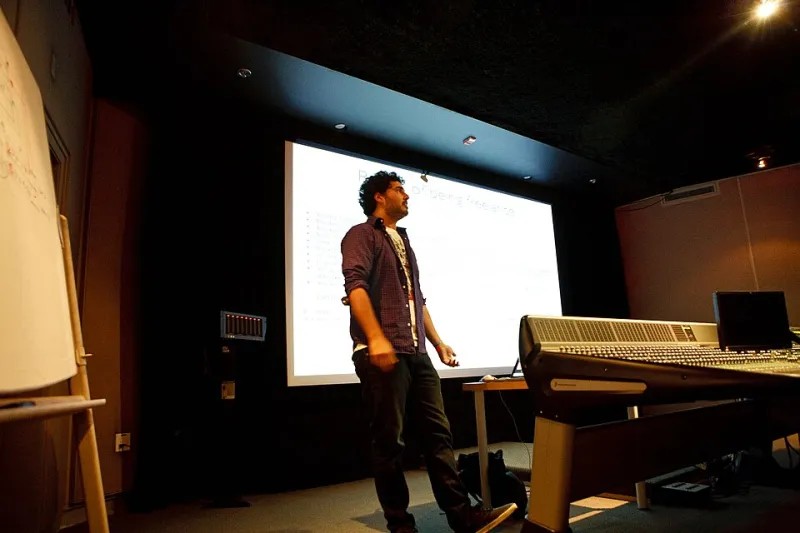
Photo: Peter Trimming, CC BY 2.0, via Wikimedia Commons
There is a small, specific moment in a creative career that nobody warns you about. It is the afternoon you type your own name into a domain search box, see it is available, and then — for reasons you cannot quite explain — buy the studio version instead.
I have done this. I suspect plenty of you have too.
tomjobbins.com makes a promise. It says: a human being reads this email, a human being quotes the job, and that same human being turns up on the day. It is an old-fashioned sort of guarantee, and in 2026 it has become quietly unfashionable.
The awkward bit comes later. You get busy. You bring in a mate to help with the edit. You land a client who keeps using the word 'team' in meetings. Somewhere in there, your own name starts to feel small — a bit sole trader, a bit Saturday morning. So a studio name goes up above the door, and the whole arithmetic of the business shifts without anyone really noticing, least of all you.
Two addresses, two different promises
A personal domain is a contract with a shorter sales cycle and a lower ceiling. It says the person who answers is the person who does the work, which means clients haggle differently, brief differently and forgive differently. You get the whole relationship, good and bad. When it goes wrong at 11pm, there is no account manager to absorb it — just you, and the file, and the kettle.
A studio domain says the opposite. It implies a rota, a process, a second point of contact for when you are on holiday. Clients ask for a deck before a chat. Procurement departments perk up. The work can scale beyond the hours you personally have available, which is genuinely useful and also the first step towards being a company that happens to do creative work rather than a creative who happens to have a company.
Neither is dishonest. But the address sets the tone before you have said a word, and it is much harder to walk backwards from 'we' to 'me' than it is to grow into the other direction.
What a personal name does to a quote
Here is the thing I keep coming back to. When you trade as yourself, pricing is transparent in a way that is oddly comforting to clients. They are not paying for an office or a business development person or a brand. They are paying for your judgement, and they know roughly what that costs because there is only one of you to price.
The moment a studio name appears, quotes tend to creep. Not out of greed — out of overhead. The website needs to look like a studio website. The deck needs a template. Suddenly you are buying furniture you would not have bought and writing case studies in the third person about yourself.
I know a Bristol illustrator who rebranded to a collective name in her late twenties, picked up two bigger clients, and then discovered she could no longer take a small, weird, badly paid job she actually wanted. The name had made her expensive. The work had not changed. She spent two years doing corporate explainer videos and being mildly miserable about it, then quietly went back to her own name, taking a chunk of the clients with her.
That is not an argument against ever using a studio name. It is an argument for being honest about why you are doing it.
The version that actually works
There is a middle path, and it is the one most sensible UK creatives land on eventually: keep the personal domain as the front door, and use the studio name as a project-specific label. You are still Tom, or Priya, or whoever answers the email. The studio name exists for the jobs where a client genuinely needs there to be more than one of you, and it can be retired when those jobs stop coming.
It means your portfolio stays legible, your invoicing stays simple, and you never have to explain to a client why the person who pitched is not the person who delivered.
The domain is a decision you make once
You will read a lot this year about personal branding, and most of it will be nonsense about consistency and pillars. Ignore that. The real decision is simpler: do you want to be a person who does the work, or a company that arranges for the work to be done? Both are fine. Both pay the mortgage. Only one of them lets you answer the phone in your own name.
If you are still early, buy the personal domain and stop overthinking it. It costs you nothing to add a studio later, and it costs a great deal to take one away.